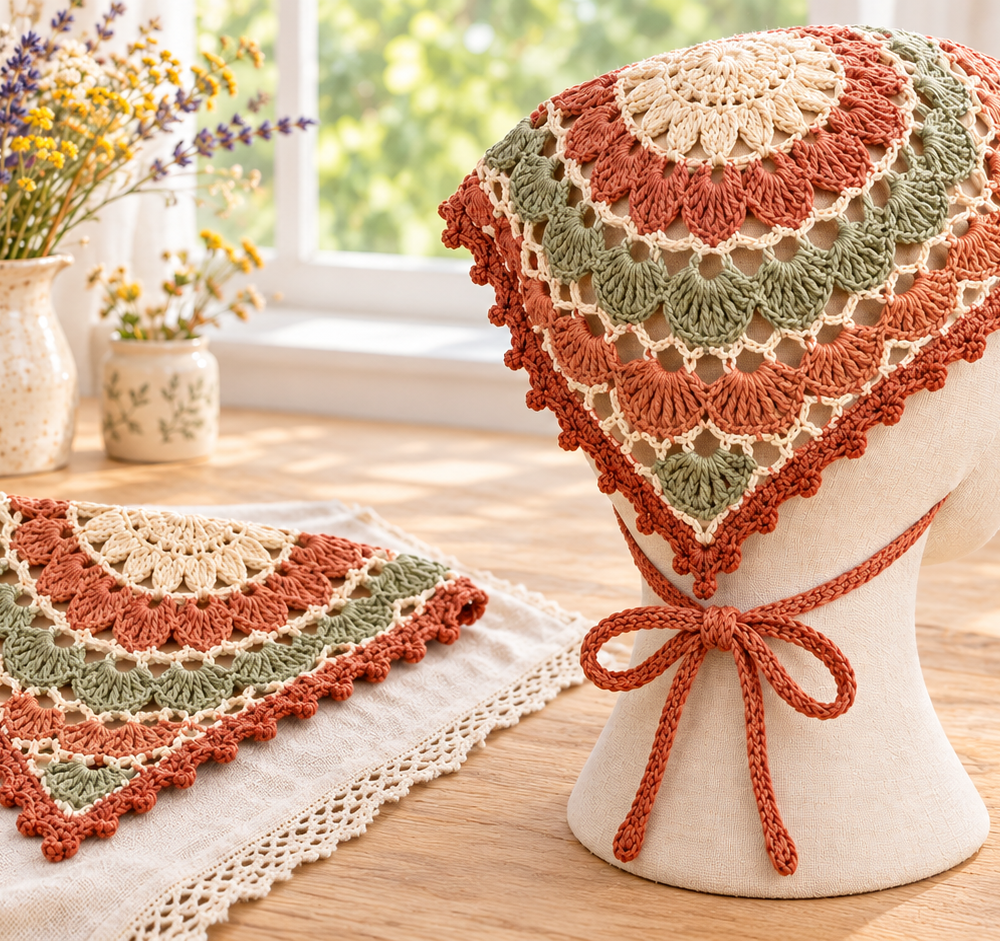
The Wildflower Medallion Crochet Bandana is an original crochet bandana concept built around a radiating half-medallion instead of conventional straight rows or joined squares. Warm ivory, dusty terracotta, and muted sage create a soft botanical palette, while fan stitches, open chain spaces, and a scalloped picot border give the triangle a light, decorative finish. This project guide explains the suggested materials, construction logic, sizing approach, finishing choices, and customization options for developing the idea into a wearable sample.
This is a conceptual project guide rather than a tested row-by-row pattern. Treat the hook size, measurements, stitch placement, and yarn quantities as practical starting points that should be swatched and adjusted before producing a final pattern.
What Makes This Crochet Bandana Distinctive
The design begins at the upper center and expands outward in curved bands. Each band uses grouped stitches that resemble overlapping petals. Small chain spaces separate those petals, adding airflow and keeping the finished fabric from becoming too heavy around the head.
Three details define the look:
- Radiating construction: the stitches spread from a compact ivory center into wider terracotta and sage arcs.
- Alternating texture and openness: solid fan stitches provide structure, while chain spaces create drape and visual rhythm.
- Framed triangular silhouette: a deeper terracotta border sharpens the point and ties the color bands together.
The integrated ties continue directly from the upper corners. This reduces bulky seams at the temples and allows the edging color to flow naturally into the closure.
Suggested Yarn and Materials
A smooth sport-weight or light DK cotton is a useful starting point for this design. Cotton gives the fan stitches clear definition, keeps the open spaces crisp, and generally feels cooler than a fuzzy wool yarn. A cotton-bamboo blend could add more drape, although a very slippery blend may allow the ties to loosen more easily.
Suggested supplies include:
- Sport-weight or light DK cotton yarn in ivory, dusty terracotta, muted sage, and deep terracotta
- A crochet hook appropriate for the selected yarn, with 3.25 mm to 4 mm as a possible swatching range
- Locking stitch markers
- Yarn needle
- Sharp scissors
- Rustproof pins and a blocking mat
A firmly twisted yarn will emphasize the petal-like stitches. Avoid an overly bulky or haloed yarn because it can blur the openwork and make the border feel heavy.
Color Palette and Styling Direction
The visualized palette uses ivory as a calm center, terracotta as the main floral color, sage as a cool counterpoint, and a deeper rust tone to frame the edge. The contrast is strong enough to show the construction without becoming harsh.
For a quieter version, work the whole triangle in one neutral shade and reserve a second color for the edging and ties. For a brighter summer version, try cream, coral, and teal. A vintage-inspired option could combine parchment, mustard, olive, and brick red.
When changing colors, keep the darkest shade near the outer edge. A stronger border visually stabilizes the openwork and helps the triangle read clearly when worn.
Estimated Sizing and Fit
Because this concept has not been physically sampled, finished measurements must be treated as estimates. A practical adult starting target is a triangle approximately 18 to 21 inches across the upper edge and 9 to 11 inches deep before the border. Each tie may begin around 10 to 14 inches, but the comfortable length depends on head circumference, hair volume, yarn stretch, and the preferred knot or bow.
Measure the intended wearer rather than relying only on a standard size. The triangle should cover the desired area without pulling the fan stitches out of shape. The upper edge should sit smoothly against the head, and the ties should secure the bandana without uncomfortable pressure.
Swatching matters even for an accessory. A small difference in the height of each fan band can noticeably change the depth of the triangle. Wash and dry the swatch as intended before deciding on the final hook size.
Suitable Stitches and Techniques
This design can be developed with standard U.S. crochet terminology and a combination of familiar techniques:
- Magic ring or adjustable loop
- Chain stitches
- Single crochet
- Half double crochet
- Double crochet clusters or fan groups
- Chain-space increases
- Picot edging
- Surface slip stitches for optional reinforcement
The main technical challenge is maintaining a flat half-circle while also encouraging a triangular outline. Increases must be distributed through the curved fan bands, while the center point needs enough extra height to keep the lower edge from becoming rounded.
Conceptual Construction Approach
1. Build the center half-medallion
Begin at the upper center with a compact half-ring in ivory. The first rows should establish evenly spaced anchor points for the fan groups. A straight upper edge is important because it becomes the edge that sits across the crown of the head.
2. Expand the terracotta petal band
Work grouped double crochets into the prepared spaces to form the first fan band. Place controlled increases near the outer edges and at planned points across the curve. If the work cups, add more spacing or increases. If it ripples, reduce the increase rate.
3. Add open chain-space transitions
A narrow ivory chain-space row separates the denser fans. This transition provides flexibility and gives the next color a clean foundation. Keep the chains consistent so the openings look intentional rather than stretched.
4. Continue with the sage and terracotta bands
Repeat the fan-and-chain rhythm while gradually lengthening the center area. The outer bands should widen enough to cover the back of the head, but the fabric should remain light and flexible.
5. Shape and frame the triangle
Use the deeper terracotta shade for a stabilizing border. Single crochet or half double crochet can smooth the upper edge, while a restrained picot or scallop can decorate the two sloping sides. Too many stitches along the border may cause ruffling, so adjust the spacing after the piece has been lightly blocked.
6. Extend the corner ties
Continue from each upper corner with narrow crochet cords or short rows of single crochet. Reinforce the connection point so the tie does not pull against a single chain space. Both ties should match in length and width before finishing.
Improving Comfort and Wearability
The upper edge needs enough stability to resist stretching, but it should not feel rigid. A row of slip stitches worked loosely across the back can provide support. Another option is a final row of single crochet worked with a hook one size smaller, provided it does not tighten the edge excessively.
Keep the tie ends smooth and free of bulky knots. Weave the yarn tails through several directions and test the joins before wearing. Tie the bandana comfortably, and discontinue use if the ties, edging, or joins show damage. This concept does not include a verified fit or safety certification.
Customization Ideas
- Make it shallower: remove one fan band or shorten the center-point shaping.
- Add more coverage: include another openwork-and-fan section before the border.
- Simplify the texture: replace the picot edging with a clean reverse single crochet border.
- Create a tonal version: use four shades from the same color family.
- Change the closure: make shorter ties for a small knot, or use wider flat ties for greater grip. Any revised closure should be tested for comfort.
Troubleshooting
The medallion cups instead of lying flat
The increase rate may be too low, or the chains may be too tight. Add increases gradually across the next band and relax the tension in the chain spaces.
The fabric ripples
There may be too many stitches in the fan groups or border. Remove a few increases and block the work before making further changes.
The point looks rounded
The center shaping needs more height. Add a slightly taller stitch or a small chain space at the center point while keeping both sides symmetrical.
The upper edge stretches
Use a firmer finishing row, a smaller hook for the final edge, or a carefully worked surface slip-stitch line. Avoid pulling the reinforcement so tightly that the bandana puckers.
The ties twist
Use consistent tension and turn the work in the same direction for each row. Blocking the ties flat can also help them settle.
Care and Blocking
Follow the care instructions on the yarn label. For many cotton yarns, gentle hand washing in cool water is a conservative choice. Support the wet piece rather than lifting it by the ties. Press out moisture in a towel without wringing, then shape the triangle and pin the border evenly on a blocking mat.
Allow the bandana to dry completely before unpinning it. Store it flat or loosely folded so the picots and fan stitches are not crushed.
Frequently Asked Questions
Is this a complete crochet pattern?
No. This is a design project guide describing a possible construction approach. A publishable pattern would require a physically tested sample, confirmed gauge, exact stitch counts, row instructions, and verified measurements.
Can beginners make this design?
An adventurous beginner familiar with double crochet, chain spaces, color changes, and basic shaping could explore the concept. Managing the increase rate and keeping the medallion flat may be easier for a more experienced crocheter.
Which fiber is best?
A smooth cotton or cotton blend is suggested for stitch definition and warm-weather wear. Swatch first because different cotton yarns vary in softness, stretch, and drape.
Can the bandana be made in one color?
Yes. A solid color will emphasize the stitch texture. Using a slightly darker border can still help define the triangular shape.
How can I adjust the size?
Change the number of fan bands, the height of the center shaping, or the width of the border. Recheck the upper-edge measurement and tie length after every adjustment.
Final Thoughts
The Wildflower Medallion Crochet Bandana combines a radiating floral structure with practical triangular shaping. Its cotton texture, open chain spaces, and integrated ties make it a strong starting point for a light decorative accessory. Swatching and physical fit testing are essential before converting the idea into exact instructions, but the construction offers many possibilities for color, depth, and edging variations.
AI-assisted design disclosure: This article presents an original crochet concept developed with AI-assisted visualization. The images are design visualizations rather than photographs of a physically completed handmade sample. The construction, fit, and measurements require testing before publication as a complete crochet pattern.