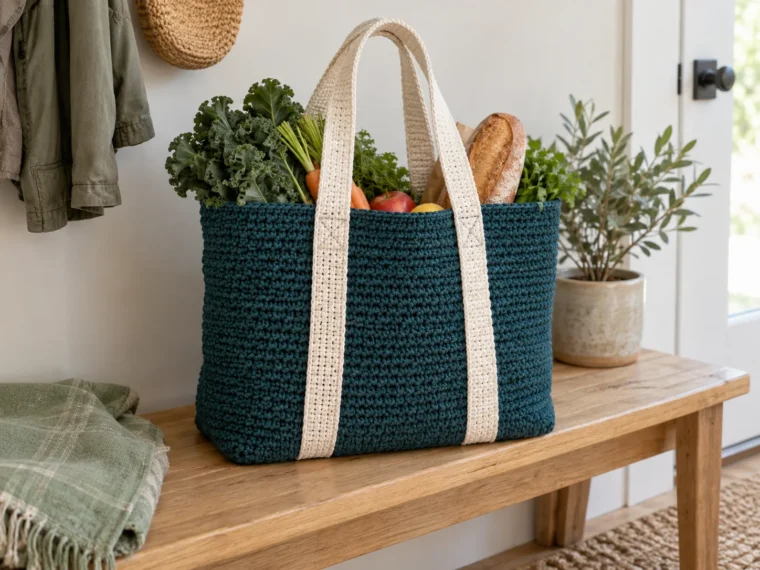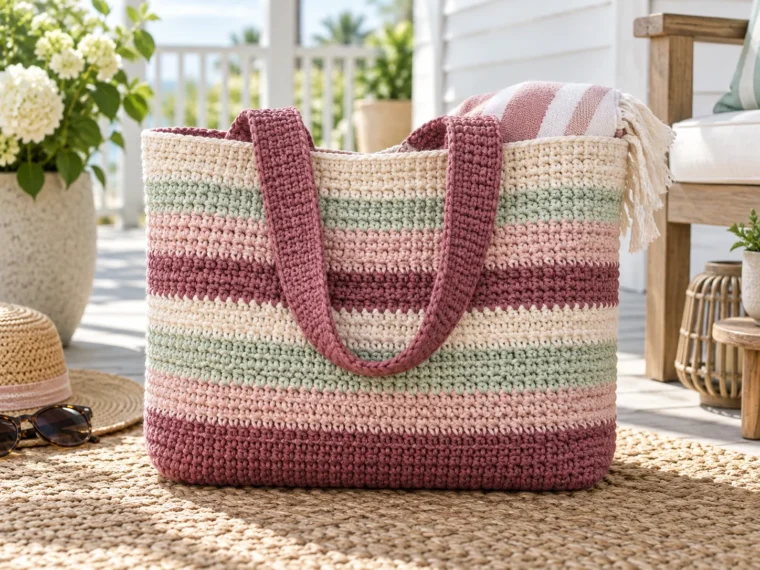
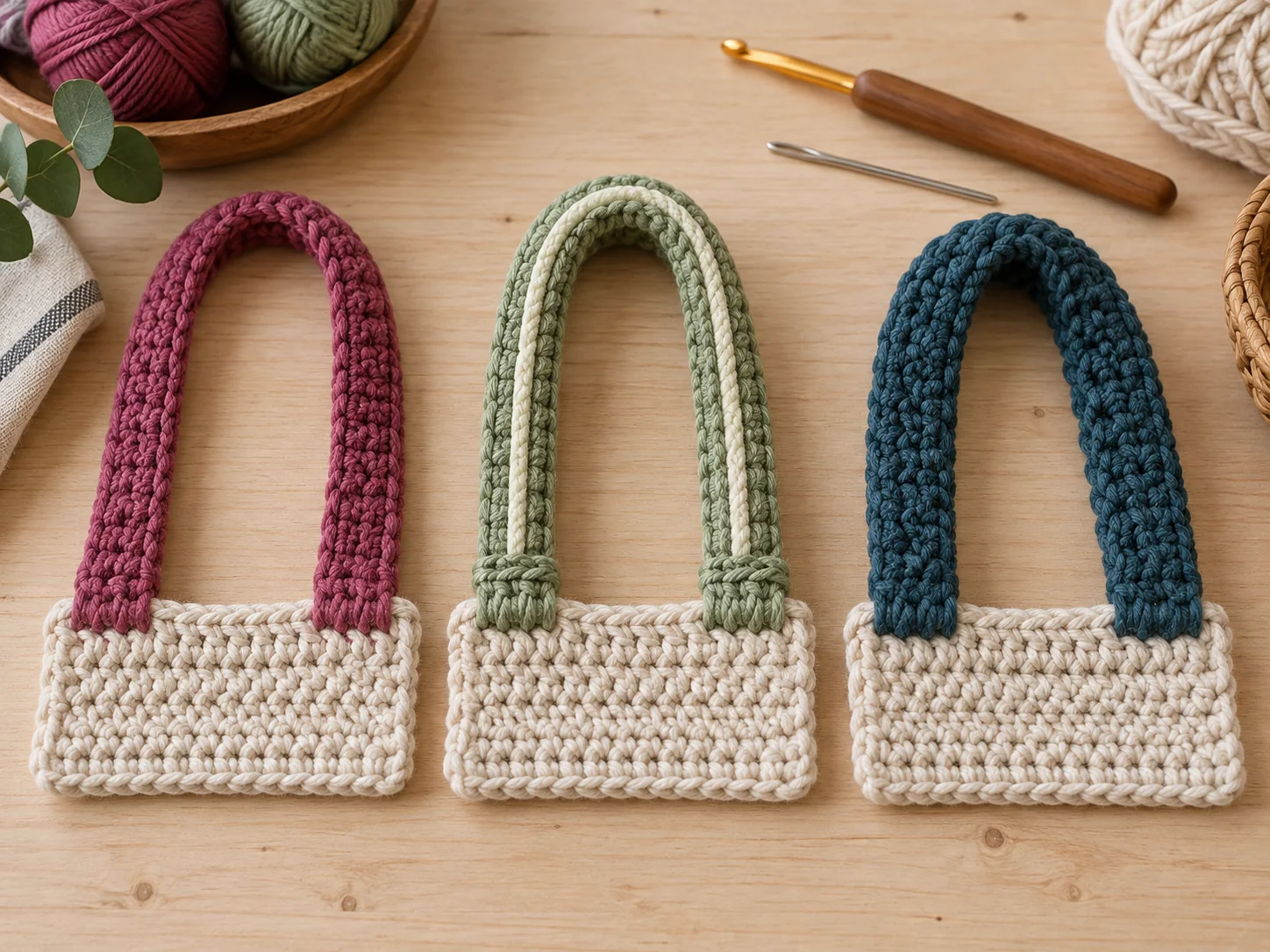
The handle is often the first part of a crochet bag to change shape. That does not mean every crochet strap will stretch badly. Stitch direction, fiber, width, attachment depth and a simple reinforcement can make a substantial difference.
Why crochet handles stretch
Crochet fabric lengthens when loops are pulled in the same direction as the load. A long chain-based strap is especially vulnerable because the foundation chain acts like a flexible spine. Slippery fibers and loose gauge allow even more movement.
Four choices control most of the result:
- Fiber: cotton and linen generally stretch less than soft acrylic or wool.
- Gauge: a smaller hook creates a denser strap.
- Direction: rows worked across a strap resist lengthwise stretch better than one long row.
- Attachment: a deep, wide attachment spreads load into the bag body.
Method 1: lengthwise single crochet strap
This is the simplest method and works well for light bags.
- Chain to the required handle length.
- Single crochet in the back bump of each chain.
- Work four to six additional rows of single crochet.
- Finish with one loose slip-stitch row along each long edge.
The slip-stitch edging limits movement, but do not work it tightly enough to curve the strap. This construction is quick and neat, although it can still lengthen under a heavy grocery load.
Best for: mini bags, lined handbags and light everyday totes.
Method 2: strap with a cord core
A stable cord inside the crochet creates the strongest result without making the handle bulky.
Materials
- Finished crochet strap or a chain long enough for the handle
- Smooth cotton cord 2–3 mm thick
- Matching yarn and yarn needle
Steps
- Cut the cord about 2 in / 5 cm shorter than the finished handle section. The cord should not extend into the attachment ends.
- Lay it along the center of a prepared strap.
- Fold the strap lengthwise around the cord.
- Slip stitch or whipstitch the long edges together, enclosing the cord without catching it repeatedly.
- Flatten the final 2–3 in / 5–7.5 cm at each end for attachment.
The inner cord carries most of the lengthwise force. Use cotton macramé cord, narrow cotton webbing or another washable material compatible with the bag. Avoid fishing line or wire, which can cut yarn or create sharp ends.
Best for: market bags, grocery totes and large shoulder bags.
Method 3: short-row thermal stitch strap
Thermal stitch creates a double-thick fabric by joining the current row to the unused loop of the row below. It takes longer but resists stretch and feels smooth in the hand.
- Chain 7 for a strap about 1.5 in / 4 cm wide.
- Single crochet in the second chain and across. Turn. 6 stitches.
- Ch 1. Insert the hook through the back loop of the current row and the remaining loop directly below it. Work a single crochet through both layers.
- Repeat across. Turn.
- Repeat Step 3 until the strap reaches the required length.
Thermal stitch grows in short rows, so the stitch direction runs across the width instead of along the loaded length. Keep the first and last stitches loose enough to maintain straight edges.
Best for: structured handbags and totes where thickness is welcome.
Attach handles so they stay secure
A strong strap can still fail if it is attached only to the top row of a bag. Overlap each end by at least 2 in / 5 cm on a small bag and 3–4 in / 7.5–10 cm on a large tote.
Pin all ends before sewing and compare the placement from the side. With strong matching yarn, sew a rectangle around each attachment area, then stitch an X through the rectangle. Pass through substantial stitches without splitting individual strands.
For granny-square bags, extend the handle end across a complete motif or into a solid top band. For mesh bags, always create a dense border before adding handles.
Reinforce an existing stretchy handle
If a finished handle has already lengthened, wash and reshape it first. Then choose one of these repairs:
- Surface slip stitch along both edges.
- Sew cotton webbing to the underside.
- Fold the strap lengthwise and seam it into a narrower double layer.
- Add a fabric lining that anchors the strap ends.
Do not shorten a loaded handle by tying a knot; the knot concentrates stress and can become uncomfortable.
Test before daily use
Place folded towels inside the bag and carry it for one minute. Measure the handle drop before and after. Add weight gradually, never beginning with breakable or dangerous objects. Inspect the attachment stitches and stop if the bag fabric distorts around them.
Quick recommendation
Choose a lengthwise single-crochet strap for a light bag, a cord-core strap for a load-bearing tote, and a thermal-stitch strap for a polished structured bag. Whichever method you use, dense gauge and deep attachment matter as much as the strap itself.