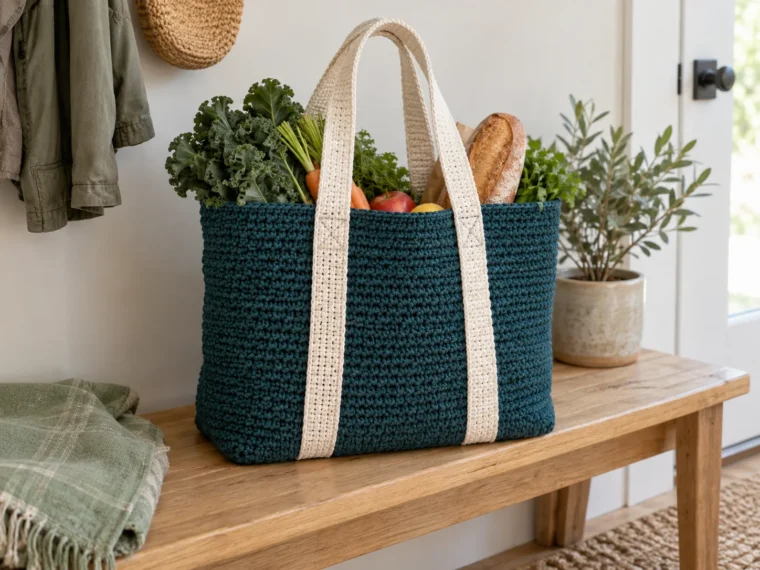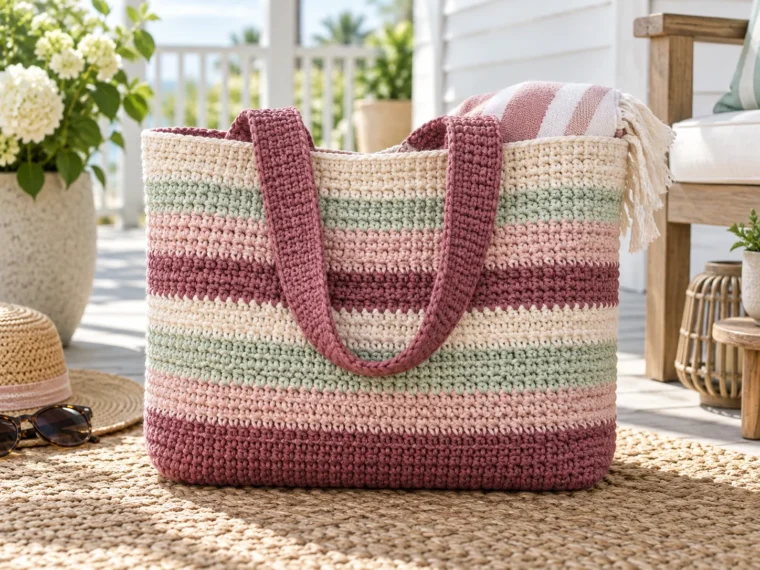
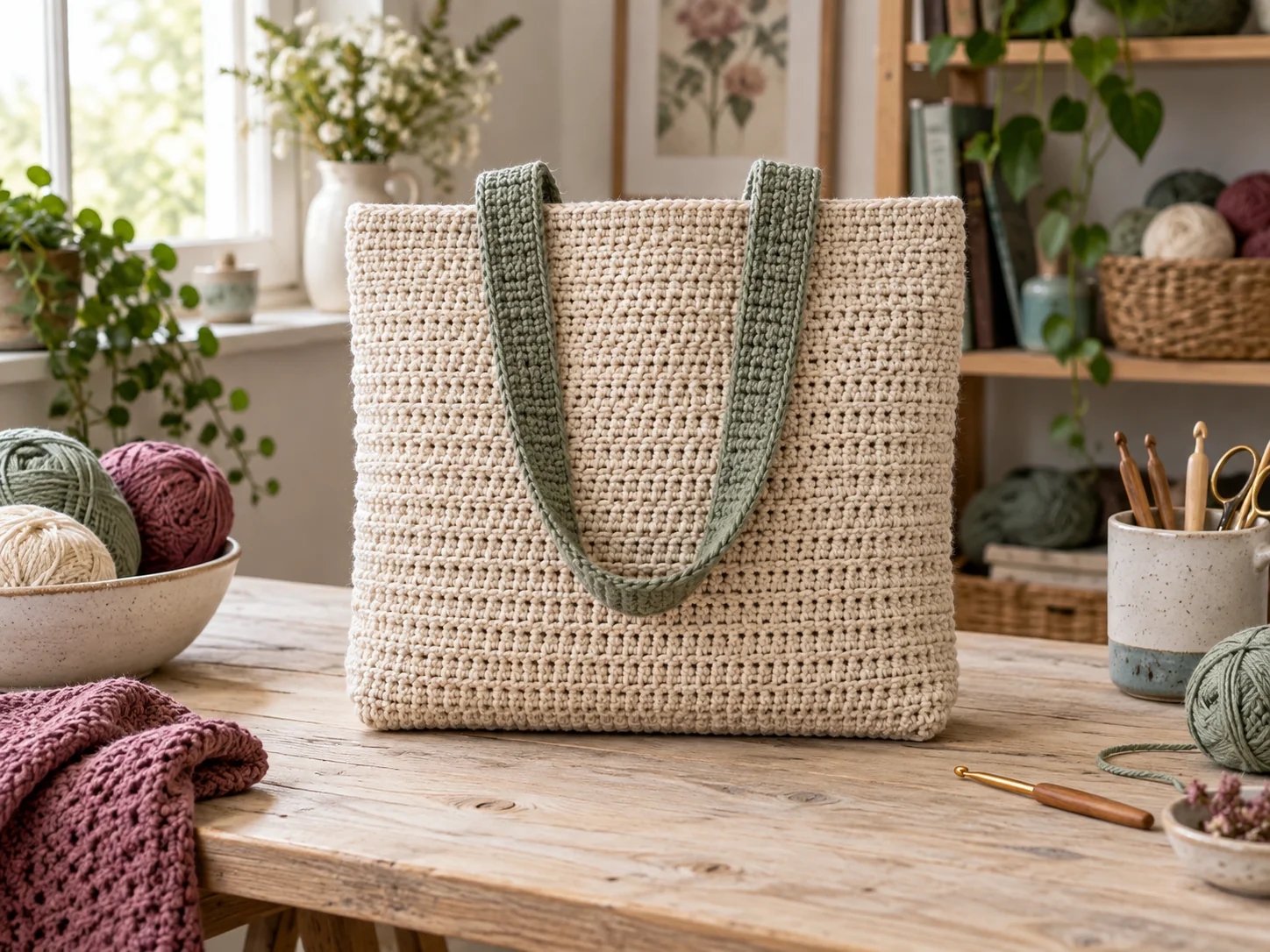
This uncomplicated tote is a good first bag because the body is made from two matching rectangles. There is no shaping to track, and the seams create enough structure for books, yarn or daily essentials. A firm cotton or cotton-blend yarn keeps the fabric useful without making it stiff.
Pattern overview
- Skill level: Beginner
- Finished size: 15 in / 38 cm wide × 12 in / 30.5 cm tall
- Handle drop: About 10 in / 25.5 cm
- Construction: Two flat panels, two straps, and three seams
- Terminology: US crochet terms
Materials
- 520 yd / 476 m worsted-weight cotton in oatmeal for the body
- 100 yd / 91 m worsted-weight cotton in muted sage for the handles
- 5 mm (H-8) crochet hook
- Four locking stitch markers
- Yarn needle and scissors
Gauge
14 half double crochet stitches and 10 rows measure 4 in / 10 cm after light blocking. A close gauge gives the tote a dense fabric. If your swatch is wider, use a smaller hook; if it is narrower, use a larger hook.
Abbreviations
- ch: chain
- hdc: half double crochet
- sc: single crochet
- sl st: slip stitch
- st(s): stitch(es)
- RS / WS: right side / wrong side
Notes before you begin
- Turning chains do not count as stitches.
- Keep the first and last stitch of every row comfortably loose so the panel edges stay straight.
- Measure both panels before fastening off. Add or remove a row if needed so they match.
Free crochet tote pattern
Make the first body panel
Foundation: With oatmeal, ch 53.
Row 1: Hdc in the second ch from the hook and in every ch across. Turn. 52 sts.
Rows 2–30: Ch 1, hdc in every st across. Turn. 52 sts.
The panel should measure about 15 × 12 in / 38 × 30.5 cm. Fasten off, leaving a 30 in / 76 cm tail for seaming.
Make the second panel
Repeat the first panel exactly. Lay the panels together and confirm that the row edges and foundation edges align.
Join the tote
Place the panels with wrong sides together. Thread the long tail onto a yarn needle. Beginning at one top corner, whipstitch down the first side, across the foundation edge and up the second side. Insert the needle through both loops along the row ends without pulling so tightly that the seam puckers.
Turn the tote right side out. Join oatmeal at either side seam and work one round of sc evenly around the top edge. Aim for about 104 stitches, placing one stitch in each hdc and one in each row end as needed. Join with a sl st and fasten off.
Make two handles
With sage, ch 61.
Row 1: Sc in the second ch from the hook and across. Turn. 60 sts.
Rows 2–5: Ch 1, sc in every st across. Turn. 60 sts.
Fasten off with a 20 in / 51 cm sewing tail. Make a second handle.
Attach the handles
Lay the tote flat. On the front, mark points 4 in / 10 cm from each side seam. Center one handle so its ends sit inside those markers and overlap the bag by 2 in / 5 cm. Pin the ends straight and check that the strap is not twisted.
Using the sewing tail, stitch a rectangle around each handle end, then sew an X through the rectangle. Repeat on the back with the second handle. Match the placement to the front before sewing.
Finishing
Weave every end through several direction changes. Lightly wet block the bag, smooth the panels square and allow it to dry flat. Do not stretch the handles while they are wet.
Customize your tote
For a wider bag, add foundation chains; for a taller bag, add rows. Maintain the same measurements on both panels. A contrast pocket can be made from a 20-stitch rectangle and sewn to the inside before the panels are joined. For heavier loads, add a fabric lining or sew cotton webbing behind the crochet straps.
Pattern check
- Both panels have 52 stitches and 30 rows.
- Side seams are the same length.
- Handle ends overlap the bag by 2 in / 5 cm.
- Every handle end has a rectangle-and-X seam.
- All yarn ends are secured before the bag is loaded.
Common questions
Can I use acrylic yarn?
Yes, but acrylic usually stretches more than cotton. Use a smaller hook for a firmer fabric and consider adding a lining.
May I sell a finished tote?
You may sell finished handmade bags in small quantities under the site’s Terms of Use. Please credit “Pattern by Fatima Becloor at CrochetBagIdea.com” when practical.