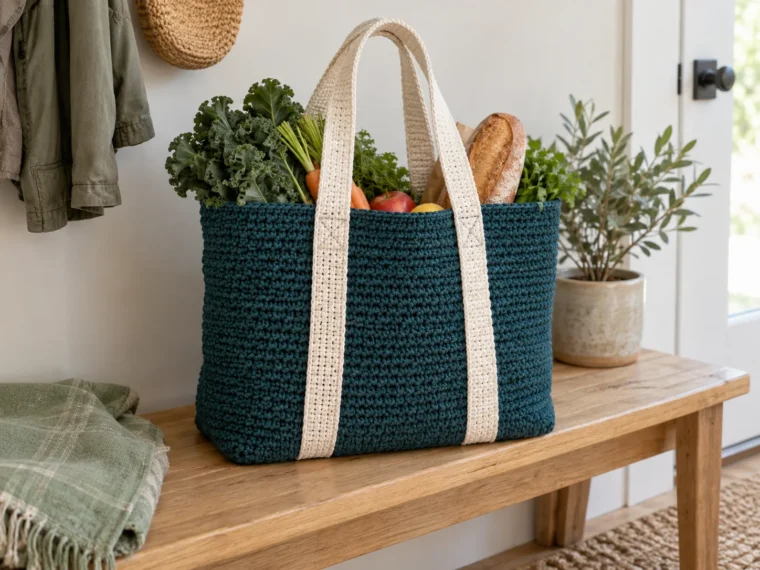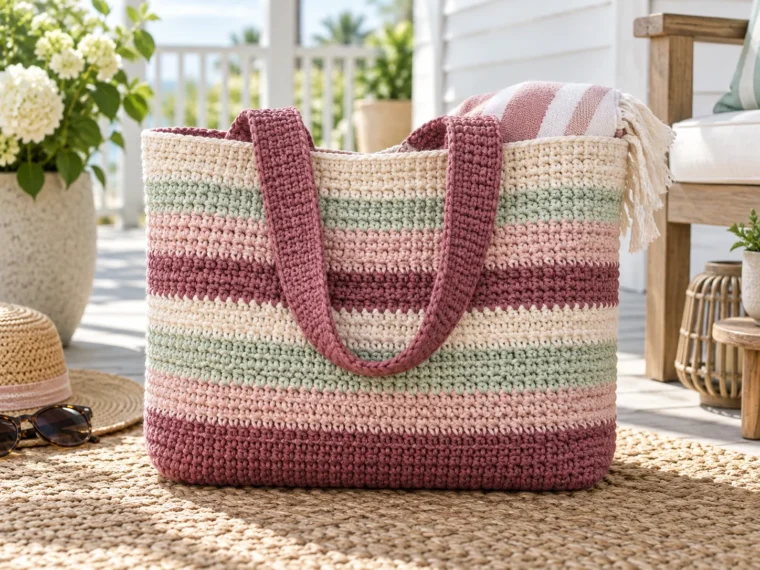
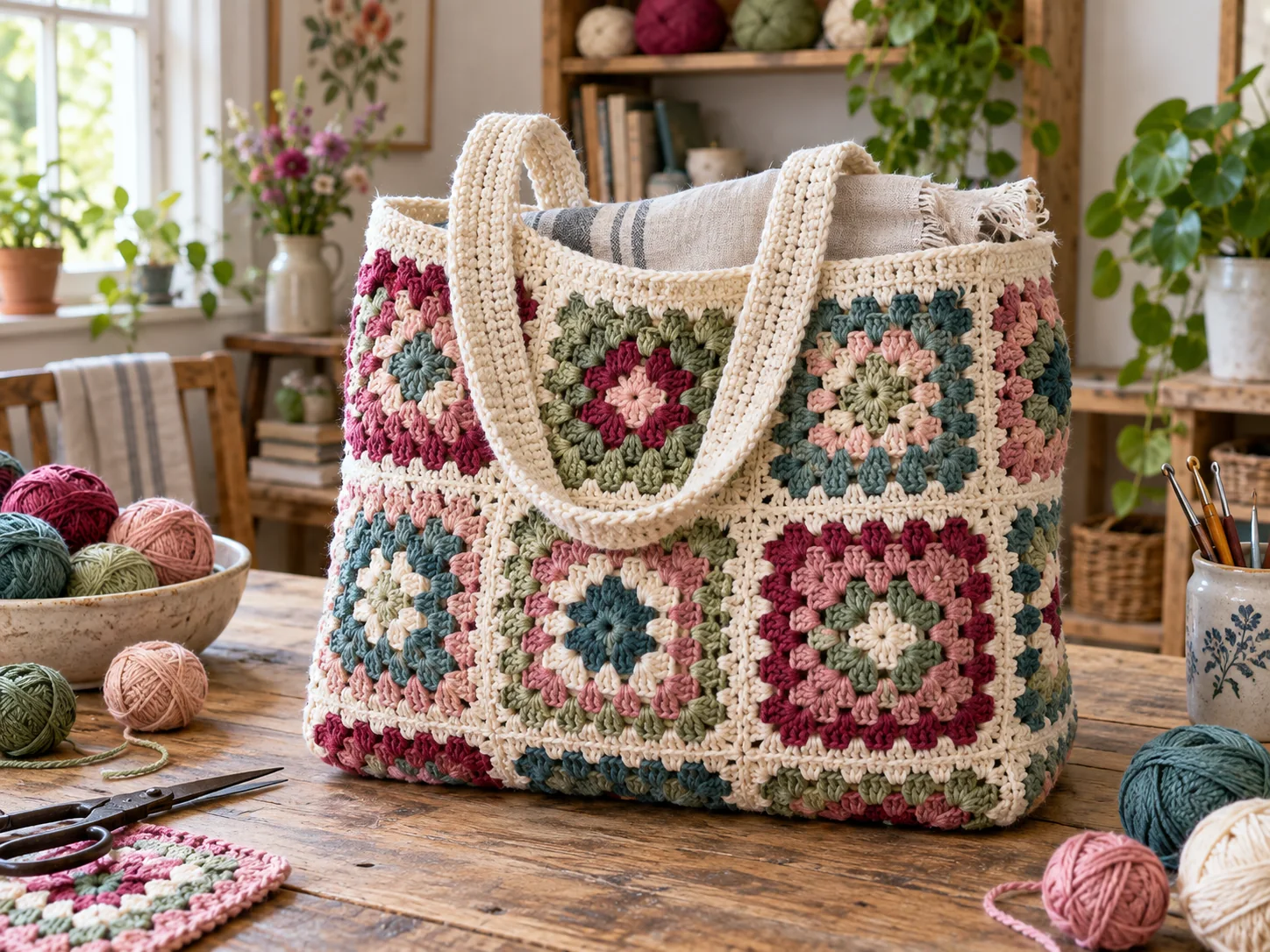
This roomy bag turns coordinated leftovers into twenty-four simple motifs. A consistent cream final round ties varied centers together, while a solid top band and wide handles make the result useful for markets, yarn shopping or everyday errands.
Pattern overview
- Skill level: Easy
- Finished size: About 16 in / 40.5 cm wide × 13 in / 33 cm tall
- Construction: Twelve squares per side in 4 × 3 panels
- Terminology: US crochet terms
Materials
- About 550 yd / 503 m total worsted-weight cotton scraps in berry, blush, sage and blue-green
- 300 yd / 274 m warm cream for final rounds, joins, border and handles
- 4.5 mm crochet hook
- Kitchen scale, optional but useful for dividing scraps
- Blocking mat, yarn needle, scissors and stitch markers
Gauge
Each square measures 4 in / 10 cm after blocking. Use only similar yarn weights. Adjust the hook for individual scraps if necessary, but keep the finished square size consistent.
Plan the colors
Weigh or estimate the leftovers before beginning. Each four-round square uses roughly 18–22 yd / 16–20 m depending on tension. Reserve the cream yarn for the final round and construction.
Make small color groups before crocheting: six berry-led squares, six sage-led, six blush-led and six blue-green-led. Vary the inner two rounds within each group. This gives the bag variety without random visual weight.
Make 24 granny squares
With the first scrap color, ch 4 and join into a ring.
Round 1: Ch 3, 2 dc into ring, ch 2; repeat 3 dc, ch 2 three times. Join. Fasten off.
Round 2: Join the next color in a corner. Work 3 dc, ch 2, 3 dc in each corner with ch 1 between corners. Join and fasten off.
Round 3: Join another scrap color in a corner. Work a corner, ch 1, 3 dc in the side space, ch 1; repeat around. Join and fasten off.
Round 4: Join cream in a corner. Work a corner, then ch 1 and 3 dc in each side space with ch 1 between clusters. Repeat around. Join and fasten off.
Weave in ends and block all squares to 4 in / 10 cm.
Arrange the panels
Lay twelve squares in a 4 × 3 grid. Spread the strongest colors across the panel rather than grouping them in one corner. Photograph the arrangement before joining. Repeat for the second panel.
Join the motifs
With cream and right sides together, slip stitch through the outer loops. Join each horizontal row first, then join the rows. At a four-corner intersection, pass the working loop through the center gap before continuing so the meeting point stays closed.
Assemble the bag
Place the panels wrong sides together. Sc through both layers down one side, across the bottom and up the second side. Place 3 sc in each lower corner. Keep the top open.
Add the top band
Join cream at one side seam.
Round 1: Sc evenly around the opening. Join.
Rounds 2–6: Ch 1, sc in every st. Join.
If the band ripples, decrease a few stitches evenly on Round 2. If it pulls, add a few stitches on that round.
Make the handles
With cream, ch 81. Sc in the second ch and across for 80 stitches. Work five more rows of sc. Fasten off with long tails. Make a second handle.
Center a handle on each panel with 6 in / 15 cm between the inner edges. Overlap ends with the band and upper motif row by 3 in / 7.5 cm. Sew a rectangle and X through each end.
Finishing
Check every join and weave in any remaining tails. Block the finished bag lightly. Add a fabric lining if the bag will carry small or heavy objects; the lining should be slightly smaller than the crochet shell.
Customize your market bag
Use 3 × 3 panels for a smaller tote or 5 × 3 for a wider one. Preserve the cream outer round to unify the design. If one scrap is thinner, hold it with a lace-weight strand or use it only for the center round.
Pattern check
- Twenty-four squares are blocked to the same size.
- Each panel contains twelve squares in a 4 × 3 grid.
- The top band lies flat.
- Handles overlap the upper motif row for support.
- Loose or novelty yarn is kept away from structural joins.
Common questions
Can I mix cotton and acrylic?
It is possible, but the fibers may stretch and wash differently. For the most predictable bag, use one fiber family or reserve a different fiber for small center rounds.